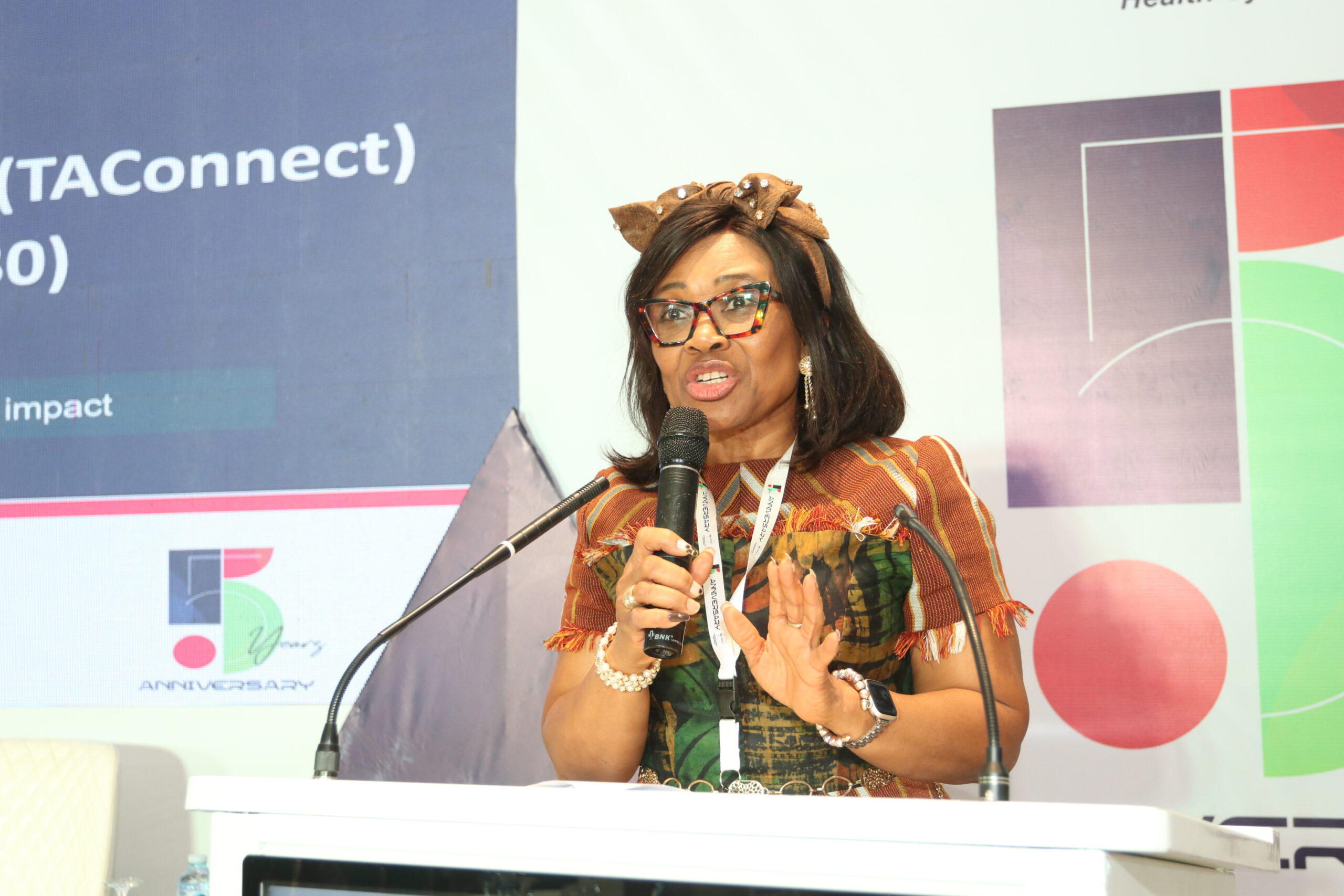
Presented by Chief Operating Officer Dr. Ochiawunma Akwiwu-Ibe, the new five-year strategy was officially launched at the event, charting TAConnect’s path to becoming one of Nigeria’s foremost hybrid grant-making and implementation organizations.
One of the most forward-looking moments of the anniversary belonged to the future. In a defining highlight of the celebration, TAConnect officially unveiled and launched its Strategic Plan 2025–2030, presented by the Chief Operating Officer, Dr. Ochiawunma Akwiwu-Ibe, who walked guests through the roadmap that will guide the organization’s next five years.
Dr. Akwiwu-Ibe grounded the strategy in the sobering realities it exists to change. Every two minutes, somewhere in the world, a woman dies while giving birth, and nearly five million children each year do not live to see their first birthday, figures that may worsen amid global aid cuts, with the Lancet estimating that more than 14 million additional people could die by 2030, including 4.5 million children under five. Nigeria carries a heavy share of this burden: the 2023 United Nations report on maternal mortality trends attributed approximately 28 percent of global maternal deaths between 2000 and 2020 to Nigeria, with an estimated maternal mortality ratio of 1,047 deaths per 100,000 live births, while neonatal mortality stands at 35 deaths per 1,000 live births.

Against that backdrop, the plan sets a bold aspiration: by 2030, TAConnect aims to be one of Nigeria’s foremost hybrid grant-making and implementation organizations, with expanded credibility and regional relevance. The strategy rests on five pillars: strengthening internal systems and governance; diversifying and growing funding, so that no single donor accounts for more than half of organizational funding by 2030; expanding programmatic scope into emerging health and development priorities while preserving excellence in health systems strengthening and Reproductive, Maternal, Neonatal, and Child Health (RMNCH); deepening stakeholder engagement and visibility; and building a continental outlook through multi-country collaborations and cross-border technical assistance.
At the heart of the plan is the theory of change that has defined TAConnect from inception: building trust with donors through transparent, efficient grant-making while demonstrating expertise through selective, high-impact programme implementation, a dual mandate that positions the organization as a trusted bridge between funders, governments, communities and implementing partners. Its strategic ambitions span stronger primary health care systems, a financially resilient institution, recognition as a partner of choice in Nigeria, and a growing role in shaping African-led health innovation.
Dr. Akwiwu-Ibe closed with the plan’s call to partnership, extended to every constituency in the room: technical assistance and evidence for governments; a tested, trusted and locally led platform for donors; strategic collaborations for development partners; shared-value investment opportunities for the private sector; and a commitment that community priorities will shape the design, delivery and accountability of TAConnect’s work. As the plan itself declares, the challenges ahead are real, and so is the opportunity to achieve more together.